Human interviewers in 2026 assess 5 things the automated stages cannot measure: judgment under ambiguity, AI literacy, cultural contribution, emotional intelligence, and team fit. Before reaching that stage, 88% of companies filter candidates using AI, and 70% use async one-way video interviews through platforms like HireVue or Spark Hire. Preparing only for the human round means preparing for a stage many candidates never reach.
The classic “What is your greatest weakness?” question isn’t going away. Neither is “Tell me about yourself.” But in 2026, those questions are no longer what determines the offer.
Before you reach a human interview, you’ve already passed three or four automated stages. Your resume cleared an ATS filter (88% of companies use AI to screen before a human reviews anything). Then your application may have been ranked by a matching algorithm. Then, increasingly, you recorded a one-way video interview through HireVue or Spark Hire: 70% of companies now use async video before a human screen. The human interviewer you finally meet isn’t starting from zero. They already know you made it through the machine. What they’re doing now is assessing five things that the machine cannot measure.
That’s what this guide covers.
What’s Actually Different About Interview Questions in 2026
Three structural shifts have changed what interviewers ask and why.
Credentials have declined, skills have risen. The “skills-based hiring” movement is real but frequently overstated. Only about 1 in 700 hires is truly credentials-free. What’s actually changed is that employers layer skills demonstrations on top of credential screening rather than replacing it. Expect to show, not just tell.
Before you reach a human interview, you have already passed three or four automated stages. Your resume cleared an ATS filter, your application may have been ranked by a matching algorithm, and 70% of companies now use async one-way video before a human screen. The human interviewer you finally meet is not assessing your qualifications from zero. They are asking what the machine could not measure.
AI literacy is now a baseline expectation, not a differentiator. Sixty-five percent of employers assess AI literacy during interviews, including for non-technical roles. Not knowing how you use AI tools at work in 2026 is the professional equivalent of not knowing how to use email in 2010. You won’t get extra credit for using AI effectively. You will get penalized for appearing not to.
Culture fit is dead. Culture add is live. Hiring teams have largely moved away from the comfort-seeking bias of “do I like this person” toward a more specific question: “does this person bring something our team doesn’t already have?” The questions that probe this are harder to prepare for on the surface, but they’re actually easier to answer well if you understand what they’re doing.
Behavioral questions now make up 60–90% of interview assessments across industries. The days of hypothetical scenario questions are mostly gone. Interviewers want past evidence.
The 5 New Question Categories (And How to Spot Them)
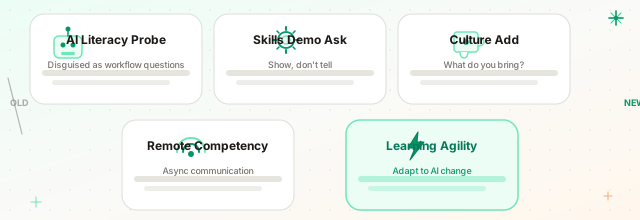
These five categories layer on top of the classic behavioral questions. They are the ones candidates routinely miss because they don’t look like what they are.
1. The AI literacy probe. Usually indirect, disguised as a productivity or workflow question. Most candidates who fail this one don’t even know they were being asked.
2. The skills demonstration ask. “Show me” replaces “tell me.” You may be asked to complete a short task, walk through your process live, or give a concrete example detailed enough to prove you can actually do the work.
3. The culture add assessment. Replaces “Are you a team player?” with “What do you bring that we don’t have?” Interviewers are explicitly looking for complementary perspectives, not consensus seekers.
4. The remote/async competency screen. Even in hybrid or on-site roles, this has become standard. Employers want evidence that you can manage yourself, communicate clearly in writing, and build relationships across distance.
5. The learning agility check. Specifically about adapting to AI-driven change. The underlying question is always: “Can this person grow faster than their role evolves?”
AI Literacy Questions — Decoding What Employers Are Actually Asking
Most AI literacy questions don’t say “AI” in them. That’s the trap.
Indirect AI questions (the most common form):
- “Walk me through how you typically handle [large volume of X].” What they’re asking: do you use AI to manage workload, or are you still doing this manually?
- “How do you stay current in your field when things change so fast?” What they’re asking: are you using AI-powered learning, newsletters, or are you passively waiting for training?
- “Tell me about a project where you had to work with limited resources or time.” What they’re asking: did you use AI to extend your capacity, or did you just work harder?
Direct AI questions (growing rapidly):
- “What AI tools do you use regularly in your work?”
- “Tell me about a time you used AI to improve a work outcome.”
- “How do you decide when to use AI assistance versus doing something yourself?”
The answer framework that works: Problem → Tool → Process → Quantified Result → What You Learned.
Example answer: “We had to analyze six months of customer feedback before a product launch. I used Claude to categorize 1,200 responses by theme in about 40 minutes, something that would have taken three days manually. The categorization surfaced a pattern we’d missed: 30% of complaints mentioned the same onboarding step. We fixed it before launch and saw a 20% drop in support tickets in the first month. What I learned was that the value isn’t just speed. It actually changes what’s possible to investigate.”
What not to say: vague claims without evidence. “I use AI tools in my workflow” tells the interviewer nothing. They want specifics: which tool, what problem, what result, what you contributed beyond prompting.
The “I don’t really use AI” answer is now the same as saying you don’t use spreadsheets. It’s not a neutral position.
Behavioral Questions Updated for 2026 (STARR Method)
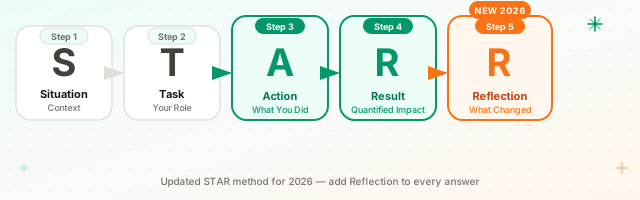
STAR still works: Situation, Task, Action, Result. But add a fifth element: Reflection. Interviewers in 2026 almost always follow up behavioral answers with “What would you do differently?” or “What did you learn from that?” Build the reflection into your answer proactively instead of waiting to be asked.
The updated format: STARR — Situation, Task, Action, Result, Reflection.
Result has also gotten more demanding. “We increased revenue” is not enough. Interviewers want scope, timeline, and your specific contribution. “Our team increased regional revenue by 18% over two quarters. My specific contribution was redesigning the sales qualification process, which cut average sales cycle from 47 to 31 days.”
Six to eight core stories cover 90% of behavioral questions. Prepare them before any interview, know them well enough to adapt them, and make sure your best one is ready to answer: “Tell me about a time you used AI to improve your work.” That question is now mandatory in 2026 interviews.
The five behavioral questions that appear in virtually every 2026 interview:
“Tell me about yourself.” This is your narrative arc, not your career summary. Start where you are, explain why you’re talking to this company, and land on what specifically makes you right for this role. Keep it under two minutes.
“Tell me about a time you failed.” They want growth mindset evidence. Pick a real failure with real consequences. Describe exactly what you did wrong and what you changed. Interviewers can tell when candidates pick a humble-brag failure. Don’t.
“Tell me about a time you disagreed with your manager.” They want to see constructive conflict: that you push back with data, advocate clearly, and can accept a decision that goes against you. What they’re filtering for: people who never disagree (yes-men) and people who make disagreement a political event.
“Tell me about your biggest professional achievement.” Prepare the full STARR version with real numbers. If you can’t quantify the impact, work harder to find a proxy metric. “Reduced new hire ramp time” is better than “improved onboarding.”
“Tell me about a time you used AI to improve your work.” If you don’t have a specific, recent, detailed answer ready, prepare one before your next interview. This question is now as standard as the failure question.
Async Video Interviews (HireVue) — Different Questions, Different Format
The format is fixed: 30 seconds to read the question, 2 minutes to answer, no re-recording. No back-and-forth. Every answer must be self-contained.
The five questions that appear in almost every HireVue:
- “Tell me about yourself.”
- “Why are you interested in this role and company?”
- “Describe a challenging situation and how you handled it.”
- “What are your greatest strengths and how would they apply here?”
- “Where do you see yourself in 3 years?”
Structure each answer as a complete unit. Use STAR in 90 seconds: 20 seconds on situation, 20 on action, 30 on result, 10 on why it’s relevant to this company. You have 30 seconds to spare. Use them for a closing sentence, not padding.
Environment matters more than people expect. Solid-color background. Camera at eye level. Ring light or window light in front of you. Record a test video before submitting. Watch it back. If you wouldn’t hire the person on that screen, fix it before you submit.
One practical tip: don’t look at yourself on screen. Look at the camera lens. That’s what eye contact looks like on video.
Culture Add Questions — What Interviewers Are Actually Probing
“Culture fit” was a proxy for “do I feel comfortable with this person?” That comfort bias systematically filtered out people who were different from the existing team, which tends to make teams worse, not better.
“Culture add” is a more specific question: does this candidate bring a perspective, skill, or approach that complements what the team already has?
The four culture add questions you’ll face:
“In what ways do your colleagues benefit from working with you as opposed to someone with your same skills?” They want a specific answer, not a generic strength claim. “I tend to be the person who writes things down and sends the meeting summary nobody asked for. My teams consistently tell me that’s what makes projects not fall apart between meetings.”
“Tell me about a time when understanding someone else’s perspective helped you accomplish a goal.” They’re probing for genuine empathy versus lip service. Give a specific example where the other person’s view actually changed how you acted, not just how you thought.
“What would you bring to our culture that isn’t already here?” This requires you to actually research the company before the interview. Look at their team page, their LinkedIn posts, their Glassdoor reviews. What’s missing? If the company is highly technical, maybe they need someone who can translate to non-technical stakeholders. Say that specifically.
“Tell me about a time you changed the way a team did something.” This is a change management question. They want the full arc: the problem you identified, how you built the case, the resistance you encountered, the result after implementation.
Framework: identify the team’s existing strength, explain the complementary skill or perspective you bring, give a specific example of that combination creating an outcome.
Questions to Ask the Interviewer in 2026
Asking good questions signals preparation, genuine interest, and sophisticated thinking about the role. Here are eight that work.
On AI adoption and tools:
- “How is this team currently using AI in its day-to-day work, and where do you see that evolving?”
- “What’s been the biggest workflow change your team has had to adapt to in the past year?”
On team dynamics and remote culture:
- “How does the team typically handle disagreements about direction or approach?”
- “For someone working remotely or in a hybrid setup, what does successful integration into this team actually look like in the first 90 days?”
On career growth and learning:
- “What does a successful first year in this role look like, and what would I have accomplished?”
- “What’s the most common reason high performers leave this team or this company?”
On the role and company:
- “What’s the biggest unsolved challenge you’re hoping this hire will contribute to?”
- “What’s changed about this team or company in the last 12 months that I should know?”
Avoid asking about salary, benefits, or PTO before you have an offer. Avoid asking anything answered in the job description. Both signal that you haven’t done basic preparation.
How to Align Your Answers with Your Resume Keywords
This matters more than most candidates realize. If your resume says “cross-functional collaboration,” say those words in your interview, not “working with other teams.” AI-assisted ATS platforms sometimes compare resume language to transcripts from async video interviews. Alignment signals consistency. Inconsistency flags as a red flag.
Run your resume through an ATS keyword optimization tool and know your top ten keywords before you walk into the interview. Use them naturally. Your resume told a story; your interview answers should continue that story, not contradict it.
If you’re being asked about a skill your resume prominently features, your interview answer needs to match the level of expertise your resume implies. Claiming Python proficiency on your resume and then stumbling through a Python question in the interview breaks trust immediately.
FAQ
What do you do if you blank on a question mid-interview?
Say “Let me take a moment to think through a good example.” Silence for five seconds is fine. Rambling for 90 seconds is not. Interviewers prefer a thoughtful pause over a disorganized answer. If you genuinely cannot think of an example, say “I don’t have a direct example of that, but let me tell you about the closest situation I’ve experienced.” That’s honest and often enough.
How do you handle salary questions early in the process?
Deflect until you have leverage. “I’d want to understand the full scope of the role before discussing compensation. Can we revisit that once we’ve both determined this is a good mutual fit?” If they push for a number, give a researched range with the lower bound at your actual floor. Fifty-five percent of candidates don’t negotiate even though 73% say salary is the top factor in job decisions. You can negotiate.
How do you handle illegal interview questions?
Questions about marital status, religion, age, pregnancy, national origin, or disability are illegal in most jurisdictions. You have three options: answer if you choose to (it’s not illegal for you to answer), redirect (“I’m not sure how that’s relevant to the role, but what I can tell you is…”), or note that the question touches on protected characteristics and ask how it relates to the position. The third option ends the interview in most cases. Know which outcome you’re willing to accept before you respond.
How do you answer “Why did you leave your last job” honestly?
Tell the truth, briefly, without excess detail or emotion. If you were laid off: “The company went through a restructuring that eliminated my department.” If you quit: “I hit the ceiling for growth there and was ready for a new challenge.” If it was difficult: focus on what you moved toward, not what you moved away from. What you absolutely cannot do is disparage the previous employer. Even if justified, it reads as a character marker.
How do you prepare differently for a panel interview versus a one-on-one?
In a panel, address your answer to the person who asked the question, then briefly make eye contact with each other person in the room before finishing. Don’t ignore the quiet panelists. They often have the most influence on the decision. Ask each panelist a question when given the opportunity. Know their names before you walk in. Check LinkedIn if the names were provided in advance.
Key takeaways
✓ Prepare for the automated stages first — 88% of companies use AI screening before a human reviews anything; your resume must clear ATS before interview prep matters
✓ AI literacy is now mandatory — 65% of employers assess it during interviews, and “I don’t really use AI” is no longer a neutral answer
✓ Use the STARR method — Situation, Task, Action, Result, and Reflection; building the reflection into your answer proactively sets you apart from candidates who wait to be asked
✓ Six to eight core stories cover 90% of behavioral questions — prepare them in advance, adapt them to fit the question, and make sure one of them answers “Tell me about a time you used AI to improve your work”