Your resume summary is the first section ATS reads and the first thing it scores. A passing summary in 2026 contains four parts: your job title (matching the posting), 3-5 hard skill keywords from the job description, one quantified result, and an industry or domain term. It should be 2-4 sentences. Soft skill adjectives like "motivated" or "results-driven" add no score and can lower your ranking in AI-augmented systems.
You spend time on your work history. You list every job with tidy bullets. Then you paste a two-line summary at the top that says something like “Dynamic professional with 8 years of experience seeking a challenging opportunity to contribute to a growing team.”
That summary will not pass an ATS filter in 2026. Not even close.
The summary section sits at the top of your resume, which means the ATS parser hits it first. On many platforms, the summary also gets extra scoring weight because recruiters search resumes by scanning it. A weak summary damages your score before the ATS even gets to your actual experience.
The resume summary is not a cover letter opening. Its job is to pass two filters simultaneously: the automated keyword match that scores your resume against the job description, and the 6-second human scan that a recruiter does when your file gets through. Generic adjectives fail the first filter. A wall of jargon fails the second.
Why ATS Systems Read Your Summary First
Modern ATS platforms like Workday, Greenhouse, and Lever assign a “match score” to every incoming resume. That score compares the text in your resume against the keywords, titles, and phrases in the job description.
The summary section gets parsed before your experience. Workday and Taleo both use the summary as a high-weight field for initial candidate ranking. That means a single well-written summary line can pull your score above the threshold that determines whether a recruiter ever opens your file.
75% of resumes are filtered before a human reads them, according to multiple industry surveys. Of those, a significant share are rejected not because of missing experience, but because the summary section either contains no relevant keywords or contains keywords that conflict with the job description.
In 2026, several major ATS platforms have added AI-augmented scoring on top of keyword matching. Tools built on top of Greenhouse Harvest and Lever use semantic analysis to assess whether a candidate’s summary actually describes the same kind of work as the job posting. “Results-driven professional” does not semantically match “data analysis” any better than it matches every other job category. These systems are specifically trained to discount filler language.
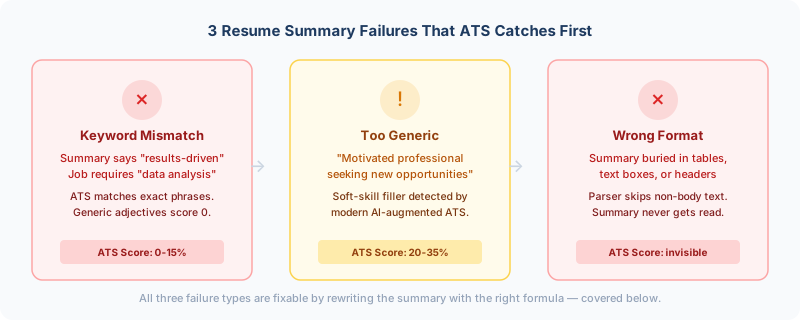
The three summary failure types and their typical ATS score impact. All three are fixable in under 15 minutes.
The 3 Types of ATS Summary Failures
Failure Type 1: Keyword Mismatch
Your summary talks about you in general terms while the job description uses specific technical language. You write “experienced in data management” while the job requires “Snowflake, dbt, and data pipeline development.”
ATS systems score keyword presence. “Data management” does not match “Snowflake.” You have described the same general competency in different words, and the parser has no way to know they’re related.
The number of relevant keywords in your summary matters more than how eloquently you describe them. A summary that reads “Snowflake, dbt, Python” scores better for a data engineering role than a beautifully written paragraph about transforming data processes.
Failure Type 2: Generic Soft Skill Filler
These phrases appear in the summary sections of nearly every resume and carry no scoring value:
- “Results-driven professional”
- “Strong communication skills”
- “Motivated team player”
- “Passionate about innovation”
- “Proven track record of success”
Modern ATS platforms using AI scoring have been calibrated on millions of resumes. They recognize these phrases as noise. Some platforms actively reduce the match score of resumes with high soft-skill-filler density because it correlates with lower candidate quality in their training data.
The word “passionate” appears in roughly 40% of all resume summaries, according to LinkedIn’s hiring data. It also appears in the summaries of candidates rejected at every stage. It adds nothing to your score and signals nothing to a recruiter. Cut it.
Failure Type 3: Wrong Format or Placement
Your summary exists in a text box, a table, a Word document header, or a text element inside a graphic. The ATS parser only reads body text. Anything else is invisible.
This mistake is less common but more damaging when it happens. If your summary is placed in a Word header (the Insert > Header feature), the ATS does not see it at all. You have a blank summary with no keyword coverage at the most-weighted field.
The same applies to creative resume templates that put the summary inside a colored sidebar column. PDF parsing of multi-column layouts is unreliable. Your summary may come out scrambled or entirely skipped.
The safe placement: plain body text, at the top of the document, before your work history section, under a standard header like “Summary” or “Professional Summary.”
The 4-Part Formula for an ATS-Passing Summary
A summary that reliably passes ATS filters in 2026 contains exactly four elements:
Part 1: Your Job Title (matching the posting) Use the exact title from the job description or a close variant. If the posting says “Senior Product Manager,” your summary should say “Senior Product Manager” or “Product Manager with 8 years of experience.” Not “seasoned product leader.” Not “cross-functional strategy professional.”
Part 2: 3-5 Hard Skill Keywords from the Job Description Read the job posting. Find the technical skills, tools, and methods listed in the requirements. Put the exact words into your summary. Use commas if needed: “skilled in Salesforce, HubSpot, and SQL.” You are not writing prose here. You are placing searchable terms.
Part 3: One Quantified Result A single metric converts your summary from a keyword holder into something a human also wants to read. “Increased pipeline conversion by 22%” or “managed a $4M annual budget” or “reduced customer churn by 15 points” all work. The number does not need to be earth-shattering. It needs to be real and specific.
Part 4: An Industry or Domain Term One word or phrase that places you in the right context: “fintech,” “B2B SaaS,” “healthcare IT,” “e-commerce,” “supply chain.” This helps both the ATS and the recruiter quickly confirm that your background is relevant to their business.
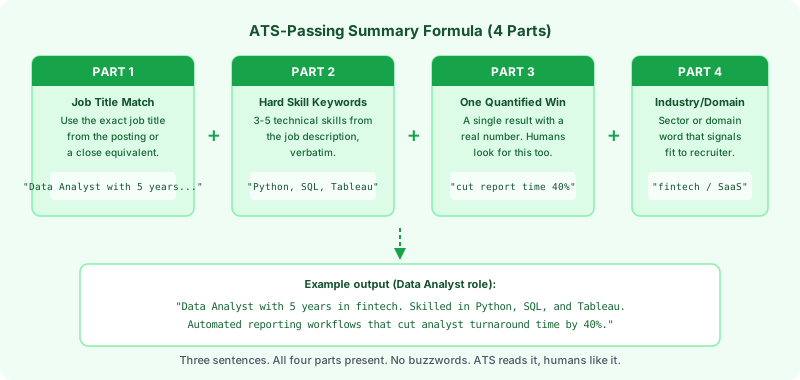
Put these four parts together in 2-4 sentences. The order can vary slightly as long as all parts are present.
Before and After Examples
Before (fails ATS): “Dynamic marketing professional with extensive experience driving brand awareness and stakeholder engagement. Passionate about creating innovative campaigns that resonate with target audiences and deliver measurable impact.”
Zero hard skill keywords. No metrics. No job title from any specific posting. “Dynamic,” “passionate,” “innovative” all scored as filler. ATS match score: near zero for any specific marketing role.
After (passes ATS for a Digital Marketing Manager role): “Digital Marketing Manager with 6 years in B2B SaaS. Skilled in HubSpot, Google Ads, and SEO. Led a content strategy that grew organic traffic by 180% in 12 months.”
Match score for a Digital Marketing Manager posting: 65-80% from the summary alone, before the ATS reads the rest of the resume.
Before (fails ATS for a software engineering role): “Collaborative software engineer who thrives in fast-paced environments and enjoys building solutions that make a difference for users.”
After: “Backend Software Engineer with 4 years in fintech. Proficient in Python, Go, and PostgreSQL. Designed a payment processing service handling 2M daily transactions.”
The transformation in both cases took under 10 minutes.
Career Changers and the “Overqualified” Problem
If You Are Changing Industries
Standard advice says to use a summary that bridges your old industry to the new one. That is correct for human readers but requires one extra consideration for ATS: the keywords need to come from the destination job description, not your current field.
If you are moving from marketing to product management, your summary should not lead with marketing skills. It should open with “Product Manager” as a title signal and then list the PM skills you have built: “user research, roadmap planning, Jira, stakeholder alignment.” Your marketing background can appear later in the experience section where it adds context.
The hardest part of a career change summary is psychological. You are proud of your current career. But the ATS is not. It scores against a job description. Write the summary for the job you want, not the job you have.
If You Are Overqualified
Overqualified candidates face a different problem. Their summaries often list too many senior keywords for a role. A VP-level summary does not score well against a Director-level posting, because the seniority signals conflict.
The practical fix: calibrate your title signal. Instead of “VP of Sales with 15 years,” try “Sales Director and team builder with 15 years.” Mirror the level in the posting. This sounds counterintuitive but it improves both your ATS score and your interview chances, because it signals that you are genuinely interested in the role rather than coasting down.
How Long Should the Summary Be?
Two to four sentences. That is the range that performs best across most ATS platforms.
One sentence is too short to include all four formula parts without reading like a keyword list. Five sentences or more introduces filler content that dilutes keyword density and drops your score.
The two-sentence version works when you have very strong keywords and one sharp metric: “Data Scientist with 7 years in e-commerce. Built recommendation models in Python and Spark that improved click-through rate by 34%.”
Three sentences is the sweet spot for most roles. Four sentences is fine if you have a strong industry context paragraph.
Over four sentences, you are writing a cover letter introduction. Keep it out of the summary.
Checking Your Summary Against the Job Description
Before submitting any application, paste your resume summary and the job description into ATS CV Checker. The tool scores your keyword coverage, flags missing terms from the posting, and shows you which phrases in the job description are highest-weight but absent from your summary.
A 5-minute check before each application catches the keyword gaps that cost you callbacks. Checking your full resume as well as the summary section gives you the complete match picture. Understanding the 12 most common ATS resume mistakes alongside this summary fix covers the two biggest levers in ATS optimization.
Key takeaways
- Use your target job title in the summary, matching the posting’s exact wording or a close variant
- Include 3-5 hard skill keywords from the job description: exact phrases, not paraphrases
- Add one quantified result with a real number to make the summary readable to humans as well
- Cut all soft skill adjectives: “motivated,” “passionate,” “results-driven,” and similar phrases add no ATS score and dilute keyword density in AI-augmented systems
- Keep the summary to 2-4 sentences in plain body text, never inside tables, text boxes, or document headers