The technical interview pipeline at most software companies now has 5 distinct stages, each capable of eliminating you before you reach a human: recruiter screen, async coding assessment, AI-aware live coding round, system design, and behavioral interview. The biggest shift in 2026 is the AI-aware coding round, piloted by Meta in late 2025 with GPT-4o, Claude Sonnet, and Gemini 2.5 Pro available to candidates during the problem. Preparing without that context means preparing for the wrong exam.
The technical interview pipeline at most software companies now has five distinct stages, each with its own screening logic, each capable of eliminating you before you reach a human. Getting good at one or two of them is not enough. You need to know what each stage is actually testing and how it has shifted in the past 12 months.
The behavioral round now accounts for 30 to 40 percent of total interview time at major tech companies, up from 10 to 15 percent five years ago. Almost every technical interview in 2026 includes a version of this question: “Tell me about a time you used AI to improve your engineering work.” Candidates who cannot answer with a specific example look out of touch in a year when AI fluency commands a significant wage premium.
The biggest shift in 2026 is not the behavioral round or system design. It is the AI-aware coding round. Meta piloted it in late 2025 using CoderPad with GPT-4o mini, Claude Sonnet, and Gemini 2.5 Pro available to candidates during the problem. The format is now rolling out to other FAANG companies and the first wave of mid-size adopters. If you have been preparing for technical interviews as though AI tools are banned, you are preparing for the wrong exam.
This guide covers all five stages in sequence, with specific preparation tactics for each one.
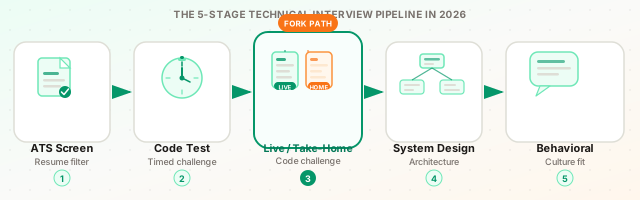
The Technical Interview Pipeline in 2026
Every stage runs before the previous one hands you off. Most candidates never think about this sequentially.
Stage 1: ATS and resume screen. Automated parsing before any human sees your application. For software engineers specifically, keyword precision matters: exact tool names, version context, scale metrics. See the full ATS resume for software engineers guide before you apply. A well-formatted resume with correct keyword coverage is the prerequisite for everything else in this list.
Stage 2: Automated coding assessment. HackerRank, Codility, or CodeSignal sends you a timed link. You have 60-90 minutes, two or three problems, and no interviewer. This is a pass/fail gate. Fail here and the pipeline ends.
Stage 3: Take-home project or live coding round. The format depends on the company. FAANG tends toward live coding. Startups and mid-size companies are splitting: 47% of hiring managers now prefer take-home projects over live coding, according to 2025 LinkedIn survey data. These formats test different things and require different preparation.
Stage 4: System design. Used to start at senior level. It now starts at mid-level, L4 by Google’s ladder or equivalent. The questions have not gotten harder at this level. The expectation that you can handle them has moved down.
Stage 5: Behavioral round. This is now 30-40% of total interview time at major tech companies, up from 10-15% five years ago. There is one question in this round that every company is asking in 2026 and almost no one prepares for specifically. More on that below.
Preparing for the Automated Coding Screen
HackerRank, Codility, and CodeSignal all work similarly: timed assessment, fixed number of problems, automated scoring on test case pass rate and sometimes code efficiency.
The most common failure mode is not difficulty - it is time management. 90 minutes for three problems sounds like 30 minutes each. In practice, candidates burn 50 minutes on problem two, leave problem three untouched, and score below the threshold. The fix: set a hard 25-minute limit per problem. If you are not making progress at 25 minutes, move to the next problem and come back if time permits. A partial solution on three problems beats a complete solution on one.
Do not over-engineer. Automated assessments score on test case pass rate. A brute-force O(n^2) solution that passes all test cases scores the same as an optimal O(n log n) solution. Write the simplest thing that works first, then optimize if you have time. Elegance is not scored. Correctness is.
Simulate the environment before the real assessment. These platforms do not have IDE features - no autocomplete, no inline error checking, no import suggestions. Practicing on LeetCode with VSCode open beside it does not simulate the actual condition. Practice on the platform itself (HackerRank and CodeSignal both have free practice modes) or use a plain text editor to simulate the stripped-down environment.
Warm up the morning of. Solve two or three easy problems before the assessment window opens. Not to learn anything new - to get your pattern-matching running. This is the same logic as warming up before a race.
The takeaway: automated screens test whether you can produce working code under time pressure without tooling support. Practice specifically in those conditions.
LeetCode Is Dead for Most Jobs (But Not for FAANG)
Here is the honest breakdown.
At Google, Amazon, Meta, and Apple, algorithmic puzzles are still 80% of the coding interview content. These companies have enough applicants to use LeetCode Hard as a filter, and they can enforce proctoring to address the cheating problem. If FAANG is your target, LeetCode is non-negotiable. Practice daily, focus on Trees, Graphs, Dynamic Programming, and Sliding Window patterns. NeetCode.io’s roadmap is the most efficient path.
For everyone else, the calculus has changed. The reason is straightforward: AI can pass LeetCode. Claude Sonnet solves LeetCode Medium in under 30 seconds. Companies outside FAANG know this, and 56% of developers have been saying for years that algorithm-based questions are not useful predictors of job performance. These two facts together have accelerated the shift away from LeetCode at mid-size companies and startups.
What these companies use instead:
- Take-home projects: Build a small feature against a real-ish codebase. Usually 3-6 hours, submitted 24-48 hours after delivery. Tests practical judgment more than algorithmic recall.
- Debugging challenges: Here is a 250-line Rails service with two bugs. Find them and explain what you changed. Microsoft, Stripe, and Airbnb have all been running variants of this format.
- System design at mid-level: Design a rate limiter, a job queue, a notification system. More on this below.
- Real-world coding tracks: CodeSignal’s Industry Coding Framework and TestGorilla’s developer assessments are built for this specifically.
If you are applying to both FAANG and startups simultaneously, you need to maintain two preparation tracks. This is a real overhead. Most people pick one based on where they are actually likely to get an offer.
The AI-Aware Coding Round
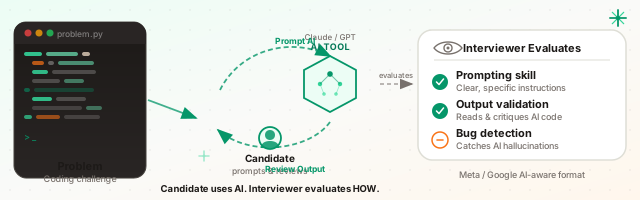
Meta’s pilot in late 2025 made the format concrete. The candidate gets a CoderPad session with access to GPT-4o mini, Claude Sonnet, and Gemini 2.5 Pro available as tools within the environment. The problem is a production-level coding task - not a toy algorithm, but something that resembles real engineering work.
What the interviewer is actually evaluating:
- How you prompt the AI. Are your prompts specific and contextual, or vague and generic? Do you give the model relevant constraints, or do you dump the whole problem and hope it figures it out?
- How you validate the output. Do you just copy-paste what the model returns, or do you read it, test it, question its edge case handling?
- How you debug AI mistakes. The model will produce code with errors - sometimes subtle ones. Identifying them demonstrates that you understand the code, not just that you can generate it.
- Final code quality. Does the submitted solution actually work? Is it readable? Does it handle the stated edge cases?
If you have been using AI tools daily in your job, this format rewards you. If you pretend you do not use AI in your work and have no practice prompting or debugging AI output, this format will expose it.
The “Debug AI-Generated Code” variant, which Microsoft, Stripe, and Airbnb have been running, works differently: you receive 200-300 lines of AI-generated code with three to five deliberately introduced bugs. A race condition. An off-by-one error. An incorrect edge case. Your job is to find them and explain the fix. This format does not require you to generate anything - it tests whether you can read and reason about unfamiliar code critically.
How to prepare for both formats:
Use GitHub Copilot or Claude in a CoderPad-like environment and practice with a timer running. Set yourself a real problem, use the AI to help, and then critically review everything it produces before accepting it. Practice explaining your AI usage out loud as you work - “I prompted it with X, it returned Y, I noticed the edge case handling was wrong, I corrected it by Z.” That narration is what the interviewer is listening for.
For the debugging variant, find AI-generated code in the wild (GitHub Copilot output, ChatGPT solutions posted on Stack Overflow), read it carefully, and practice identifying the errors before running it.
The takeaway: the AI-aware round rewards engineers who use AI fluently, not engineers who either refuse to use it or use it blindly.
System Design Preparation for Mid-Level and Above
The level shift is the most important change in 2026 technical interviews. System design used to be a senior-level gate. It is now expected from L4/mid-level up. If you have three or more years of experience and you are not preparing for system design, you will hit this wall unexpectedly.
What mid-level system design looks like: notification system, URL shortener, rate limiter, distributed cache, newsfeed, job queue. These are not as complex as the Uber-backend-at-10M-users questions that used to define senior-level design interviews. They are tractable. The problem is that many mid-level engineers have never thought about them systematically before the interview.
The four things interviewers evaluate:
- Problem navigation: Do you ask clarifying questions before designing anything? Do you define scale assumptions, user counts, read/write ratios, consistency requirements?
- Solution design: Is your proposed architecture appropriate for the stated constraints? Do you explain your component choices?
- Technical excellence: Do you understand the trade-offs in your design? Can you discuss alternatives you considered and why you chose otherwise?
- Communication: Can you explain your reasoning clearly to someone who cannot see inside your head?
The most common mistake: jumping to architecture before defining requirements. A candidate who immediately draws boxes and arrows when asked “Design a notification system” has failed the first evaluation criterion before they have said anything about components. Spend the first five minutes asking questions: What types of notifications? Push, email, SMS? What scale? What delivery guarantee - at least once, exactly once? What’s the acceptable latency? The interviewer is watching whether you know to ask these questions.
Resources that actually help:
- HelloInterview.com is the best current platform for structured system design practice with feedback. Not free, but worth the cost for focused prep.
- The System Design Primer on GitHub (github.com/donnemartin/system-design-primer) is the canonical free resource for concepts.
- Exponent has good video walkthroughs of common prompts with commentary on what interviewers look for.
Practical schedule: Design one system per week from scratch, without looking anything up, then compare against documented solutions. Five weeks of this covers most of what comes up at mid-level interviews.
The takeaway: if you have three or more years of experience, system design preparation is no longer optional.
Behavioral Questions for Engineers in 2026
Every technical screen now ends with behavioral questions. At most companies, this round takes 30-40% of the total interview time. It is not a soft skills formality - it is scored, and candidates who walk in underprepared lose points that kill an otherwise strong technical performance.
The mandatory AI story. Every technical interview in 2026 has a version of this question: “Tell me about a time you used AI to improve your engineering work.” If you cannot answer this with a specific example - what problem, which tools, what you did, what the result was - you look out of touch in a year when AI fluency commands a 56% wage premium. The question is not asking whether you use AI. It is asking whether you have thought about how you use it.
If you are early career and do not have production AI usage to cite, use a learning or personal project example. What you cannot do is give a vague or hypothetical answer. “I’ve been exploring how AI might help with…” does not pass this question.
The learning agility question is now standard alongside it: “How do you stay current when the field changes every six months?” The expected answer involves specific habits: following specific people, reading specific sources, building side projects, not just “staying curious.”
Five common behavioral prompts at tech companies in 2026:
-
“Tell me about a time you disagreed with a technical decision and how you handled it.” Framework: State the context, your concern, how you raised it, what happened, what you learned.
-
“Describe a time you had to deliver under a tight deadline and what trade-offs you made.” Framework: Be specific about what you cut, why, and how you communicated it.
-
“Tell me about a time you made a significant technical mistake and how you recovered.” Framework: The mistake matters less than your accountability, your fix, and what you changed afterward.
-
“Tell me about a time you used AI to improve your engineering work.” Framework: Specific tool, specific problem, specific outcome. Include what you had to correct or validate.
-
“How do you keep your technical skills current?” Framework: Name specific resources, communities, or habits. General answers fail this question.
The STAR format (Situation, Task, Action, Result) still holds. For engineering behavioral interviews specifically, make the Result quantifiable when possible: “reduced build time by 40%,” “shipped two weeks early,” “zero incidents after migration.” Numbers land better than adjectives.
The takeaway: prepare five stories before your first interview. Behavioral questions are the most predictable part of the technical interview pipeline. Not having prepared stories is a choice to lose points you could easily keep.
Best Tools for Technical Interview Prep in 2026
Organized by what you are preparing for:
Algorithms and data structures:
- LeetCode - still the standard. Use the NeetCode roadmap to prioritize rather than grinding randomly.
- AlgoExpert - paid, but structured with video explanations. Good for candidates who learn better with walkthrough content than raw problem sets.
- NeetCode.io - free, excellent pattern-based roadmap. Start here before deciding whether to pay for anything else.
Live coding practice:
- Pramp - free, peer-to-peer mock interviews with video. The lack of feedback quality control is a real limitation, but it is free and the realistic pressure is valuable.
- interviewing.io - anonymous mock interviews with engineers from FAANG companies. Higher quality feedback than Pramp. The anonymized version is free; the FAANG-engineer sessions are paid.
System design:
- HelloInterview.com - structured prompts with scoring rubrics. Best current resource for getting feedback on your design thinking, not just the design itself.
- System Design Primer on GitHub - free, comprehensive, conceptual foundation.
- Exponent - video walkthroughs with interviewer commentary. Good for understanding what signals interviewers are actually looking for.
AI-aware round preparation:
- CoderPad’s self-practice mode with Copilot or Claude available - simulate the format directly.
- Final Round AI - real-time AI coaching during mock sessions. Useful for getting used to using AI assistance under time pressure.
Behavioral:
- Yoodli - AI-powered speech analysis that flags filler words, pacing, and structure in your answers. Genuinely useful for candidates who have never recorded themselves answering behavioral questions.
- Final Round AI - also covers behavioral with real-time prompting.
Honest take: do not buy everything. Pick one algorithm platform, one system design resource, and one behavioral tool. The marginal return from stacking platforms is low compared to spending more time in deliberate practice with fewer tools.
4-Week Technical Interview Study Plan
90 minutes daily is enough if it is focused. Unfocused study for three hours is worth less than focused study for 90 minutes.
Week 1: Foundation and audit
- Day 1-2: Run your resume through ATS CV Checker against three target job descriptions. Fix keyword gaps and formatting issues. Do this before anything else - a filtered resume means the rest of this plan produces no interviews. Use the technical keywords guide alongside it.
- Day 3-4: Set up your GitHub profile. Clean README on pinned repos, active contribution history, no dead repositories pinned.
- Day 5-7: Solve 15 easy LeetCode problems across arrays, strings, and hash maps. The goal is not to learn new algorithms - it is to warm up pattern-matching and get comfortable coding without IDE support.
Week 2: Core algorithms and system design fundamentals
- Algorithms: Solve 5 medium problems daily. Focus on Trees, Graphs, and two-pointer/sliding-window patterns. These appear across both FAANG and automated screens.
- System design: Read System Design Primer’s core chapters. Design URL shortener and rate limiter from scratch. Do not look up solutions until you have attempted each one for 45 minutes.
- AI coding: One 45-minute session using Claude or Copilot to solve a problem, followed by reviewing and critiquing what the AI produced.
Week 3: Applied practice
- Take-home simulation: Take one 4-hour block and complete a realistic take-home project (build a small REST API, add tests, write a README). Practice the discipline of scoping to what is achievable in the time given.
- System design: Design newsfeed and notification system. Use HelloInterview.com for at least one session with structured feedback.
- AI debugging: Find three pieces of AI-generated code (GitHub, Stack Overflow, or generate them yourself), read them carefully, identify errors before running them.
- Behavioral: Write out five STAR stories covering the prompts above. Record yourself saying them. Watch the playback once.
Week 4: Mock interviews and polish
- Complete two Pramp sessions or one interviewing.io session. The discomfort of performing under realistic conditions with a stranger watching is the point.
- Complete one HelloInterview.com system design session.
- Review your behavioral stories. Tighten the language - most first drafts are too long.
- Logistics: Confirm your technical setup (camera, microphone, CoderPad access), research each company’s specific interview format before the call, prepare two or three thoughtful questions for each interviewer.
FAQ
How do I prepare for LeetCode if I am applying to FAANG and startups simultaneously?
Run two tracks, but weight them by application volume. If you are applying to 15 startups and 2 FAANG, spend 60% of algorithm time on practical debugging and take-home project skills. If the ratio is inverted, invert the allocation. The mistake is spending all your time on FAANG-style LeetCode prep when most of your interviews are at companies that no longer use that format.
What do I do if a company says “no AI assistance” and I have been using AI tools daily?
Comply with the rule they set and perform accordingly. Do not misrepresent your practice environment - if you have been coding with Copilot for two years and have genuinely weaker raw recall as a result, that will show under the restriction. Use weeks 1-3 of this plan to rebuild your unassisted fundamentals before the interview. Also: a company that bans AI tools in interviews is telling you something about their engineering culture. That is useful signal about whether you want to work there.
How do I answer the AI story question if I am early career and have not used AI in production?
Use a personal project or coursework example. “I built a web scraper using Python and used Claude to help me design the data schema and debug my async concurrency issues. I had to correct the AI’s initial suggestion because it did not account for rate limiting from the target site” is a legitimate, specific answer. What does not work is a hypothetical or vague claim. Have an actual example, even if it is not from a professional context.
Which do hiring managers prefer - take-home projects or live coding?
47% of hiring managers prefer take-home projects over live coding, but this preference is not evenly distributed. Startups and product companies lean heavily toward take-homes. FAANG and competitive early-stage startups still use live coding with algorithmic content. Research the specific company before your screen by looking at Glassdoor interview reviews from the last 6 months. The format has been shifting quickly enough that 2024 data may be outdated.
What if I have less than three years of experience and get a system design question?
Treat it as a structured conversation, not a test of architectural knowledge you do not have. Start by asking scope-defining questions. Draw the simplest possible architecture that works at small scale. Acknowledge where it breaks as scale increases. Discuss what you would change with more time. Interviewers asking system design questions to junior or early-mid candidates know you are not going to produce a Stripe-grade distributed system design. They are evaluating your structured thinking and your willingness to reason about trade-offs, not your output. “I do not know” is an honest answer, but “I’m not sure - here is how I would think through it” is a better one.
Key takeaways
✓ Five-stage pipeline — ATS screen, automated coding, live or take-home coding, system design, and behavioral; each stage can end your candidacy before the next begins
✓ AI-aware coding round — the format rewards engineers who prompt specifically, validate AI output critically, and debug AI mistakes rather than accepting them
✓ System design starts at mid-level — the expectation has moved to L4 and equivalent; three or more years of experience means this is no longer optional preparation
✓ Prepare five behavioral stories — behavioral questions are the most predictable part of the pipeline and the easiest to prepare for; not having stories ready is a choice to lose points